

Money => Mouth
Why I've been circling this idea for a year, and I never realized I was doing it until I started organizing the YouXAI Summit

Hi there!
I’m writing to you today from Round Rock, Texas, the up-and-coming suburban city just to the north of Austin…home to Dell, The Round Rock Express baseball team, and James Talarico!
In this edition:
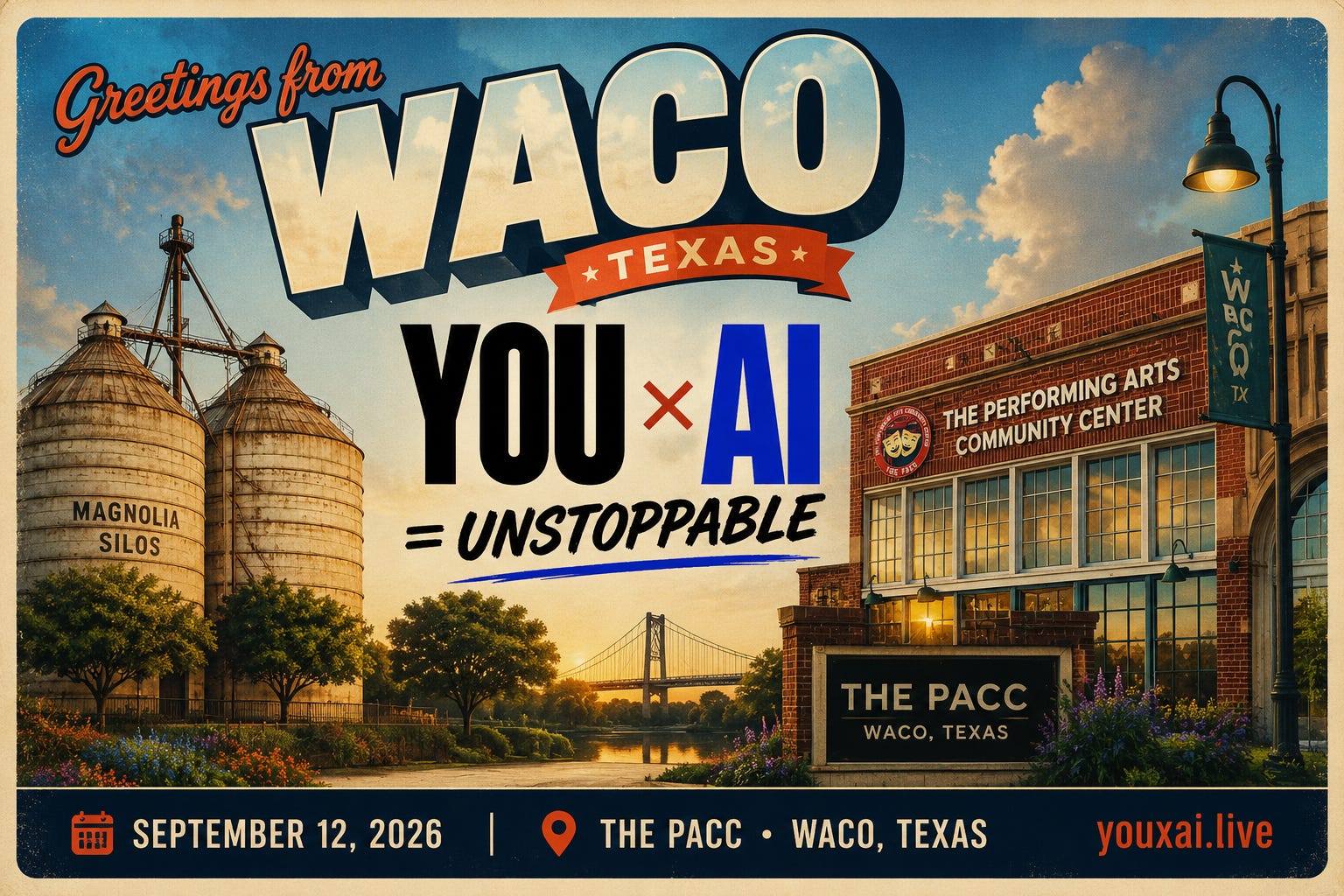
The YouXAI Summit, September 12th, 2026
Why the Viral Genius Framework could be the next business model for the post-AI era
Why you might already be positioned to be found on AI
I’m putting my money where my mouth is

Me with Hope Koch, closing keynote for YouXAI, at the set of Rogue Media Network
A few weeks ago I repositioned this newsletter from Strike Marketing to B2B Events. My thesis: in-person and virtual events are the post-AI marketing cheat code.
And because I’m so immersed in my daily tasks (sometimes it feels like I’m a trout swimming upstream against a current of tasks), I hadn’t realized: I’m already doing the B2B events thing!
I’m actually organizing the You X AI = Unstoppable summit in Waco, TX, on Sept. 12th!
I’m literally already putting my money where my mouth was!
Come to Waco Sept. 12th
Look, I get it. Waco has had a bad rap in the past. But I’m telling you, it’s a different city.
Chip and Joanna Gaines, the TV personalities from the reality show “Fixer Upper,” have built Magnolia Market, a flagship retail experience featuring home and garden shops, a baking company, coffee shop, and a lawn with food trucks.
You also have Baylor University. The Dr. Pepper Museum. Startup Waco. 25N coworking, and so much more.
It’s a rising city.
And we’re hosting the You X AI = Unstoppable summit there at the beautiful Performing Arts Community Center.
The premise: the future doesn’t belong to the people who use AI the best. It belongs to the people who use AI to amplify what makes them unmistakably human.
Some of the notable speakers:
Bryan Eisenberg, New York Times bestselling author of 11 books, including “Call to Action” and “Waiting For Your Cat To Bark
Hope Koch, Godfrey Sullivan Professor of Information Systems and Business Analytics, Hankamer School of Business · Baylor University
Russ Henneberry, co-author of Digital Marketing for Dummies. He’s the Founder of theCLICK, an AI marketing training and community platform for the modern marketer.
Andrew Lane, founder of Design Hacker and Brand Builder Pros, helping entrepreneurs leverage AI to build standout brands, marketing assets, and visual identities that convert.
Tommy Landry, founder and principal of Return On Now, an Austin, Texas-based digital marketing and AI visibility consultancy.
Two international students from Baylor who have created and launched an AI app called AdmitAI that helps foreign students navigate the American university application process
To get to know them, check out our YouTube channel where we’ve posted interviews with our speakers (more videos coming soon).
And much much more…
Come to Waco! I’d love to see you there!
Click here to register - early bird pricing of $59 ends July 31st.
Why the Viral Genius Framework could be the next business model for the post-AI era
I recorded my first video in a series on the Viral Genius Framework (the framework that undergirds the YouXAI Summit).
Outside Lamppost Coffee in Round Rock, eleven months ago, my friend Bryan Eisenberg went quiet in the middle of our conversation.
I’d been explaining how I work with founders: the interviews, the pattern-hunting, their beliefs, and how I was turning those into books and events.
He stared off into the trees long enough that it got awkward. Then he looked at me and blurted out: “Viral Genius.”
I said, “Viral Genius?”
He saw the perplexed look in my eyes, and went on to explain: “What you do for founders…by extracting their hidden zone of genius…that’sthe Viral Genius Framework!”
I thought it was a really clever name. I tested it out at networking events, and with friends.
Everybody was intrigued. One company owner said, “That’s a really cool name.”
Then I ignored it for almost a year.
And the other day I got together with Bryan again, and I was explaining to him the concept of the YouXAI Summit.
He looked at me with that look in his eyes that said, “Are you serious?”
He said, “That’s the viral genius. You’ve been ignoring it for a year, but it’s all you’ve been doing.”
You see, I was uncomfortable with the word “viral” because I wasn’t making anybody go viral with the LinkedIn algorithm. I was just sharing their ideas.
Bryan clarified: “Think about it. You’re helping extract their unique ideas and getting their ideas to spread. It’s like TED: ideas that spread.”
Ahhhhh, now it all makes sense. And yes, I’ve been circling around this idea for years!
What I’ve been running away from has been staring me in the face the whole time, and I never noticed it.
So I decided to go all in on my own zone of genius.
This week I published the first episode of a seven-part video series built around those two words. It’s embedded above, and I want to give you the short version of why it exists.
The AI shift that spurred the framework
You’ve felt the shift even if you haven’t named it.
You read a post and it’s pretty good. Then you read another, and another.
Different authors, different industries, all polished, all articulate, all forgotten ten seconds later.
AI has made average incredibly easy to create, and when average becomes free, being average stops being valuable.
We’ve hit one of those rare moments when technology changes the basis of competition itself.
The Industrial Revolution commoditized manufacturing.
The internet commoditized distribution.
AI has commoditized average.
So what becomes scarce? The things no model can generate on your behalf: judgment, taste, originality, trust, humanity.
The hundred-year-old story that’s still relevant today
There’s a hundred-year-old story that explains what to do about it.
Claude Hopkins, the copywriter behind Scientific Advertising, was hired to fix sales for Schlitz Beer.
The brewmasters walked him through their process:
Bottles sterilized with live steam.
Water drawn from deep artesian wells.
Obsessive filtration at every stage.
Hopkins asked why they didn’t tell people any of this. The brewmaster shrugged: “Every brewery does this!”
“Maybe they do,” Hopkins said. “But your customers don’t know that.”

Schlitz became one of the biggest beer brands in America without changing the beer. They changed what people noticed.
And I’m convinced every founder has a Schlitz moment of their own. Something clients constantly thank you for that you’ve stopped seeing, because you’ve lived with it too long.
The Viral Genius Framework is a five-step answer to that blindness, and the episode walks through every step.
You find what you’re blind to: the stories you keep telling, the questions people always ask you, the process that feels ordinary to you and remarkable to everyone else.
You give it a name, because your genius isn’t useful until people can remember it. You turn it into intellectual property - books, frameworks, summits, keynotes - assets that compound instead of content that evaporates.
You create trust experiences, because AI can generate infinite information but it can’t create the shared human gatherings where trust actually gets built.
And then, only then, you bring in AI to amplify it all. The order is the argument. Amplified average is still average, just louder.
One line from the episode matters more than the rest. Five years from now, nobody will ask whether you know how to use AI; they’ll assume you do, the way nobody asks today whether you know how to use email.
The question they’ll ask is why should I choose you. Your answer won’t be your product or your prompts. It will be the person you’ve spent your entire life becoming.
It took Bryan five seconds to see my viral genius. It took me eleven months to believe him. My hope is this series helps you find yours a whole lot faster.
Next week, Episode 2: how I actually start excavating a founder’s genius, and why the answers are almost never where people expect.
What’s the thing your clients keep thanking you for that you’ve stopped noticing? Hit reply and tell me. I read every response.
Note: I created an app to get the process started. Answer 12 questions about you and your business here, and you’ll get a complete strategy:
Positioning
Messaging
Your new category
A plan for your book, event, content cascade.
Check out the app here:
One Brilliant Idea: Tell the Same Story Everywhere — or AI Tells Your Old One
Tell the same story everywhere, or AI will tell your old one for you.
That’s the warning from Tommy, founder of ReturnOnNow and a YouXAI Summit speaker.
ChatGPT and Claude describe your business by assembling signals from your homepage, about page, LinkedIn, directories, and reviews.
If your messaging has evolved but half your properties still say the old thing, the models get confused.
They’ll place you in the wrong market, against the wrong competitors.
Tommy’s fix costs nothing: audit every channel you control and make sure each one describes you the same way.
Catch Tommy’s full talk at YouXAI, September 12 in Waco.
That’s it for today’s newsletter, and I’ll see you next week!