

Our opening keynote invented conversion rate optimization
Bryan Eisenberg wrote the book on persuading people online...eleven of them, actually. On September 12 in Waco, he opens YouXAI. Early bird is $59 through July 31.

I get to make a big announcement today, and I’ve been sitting on it impatiently.
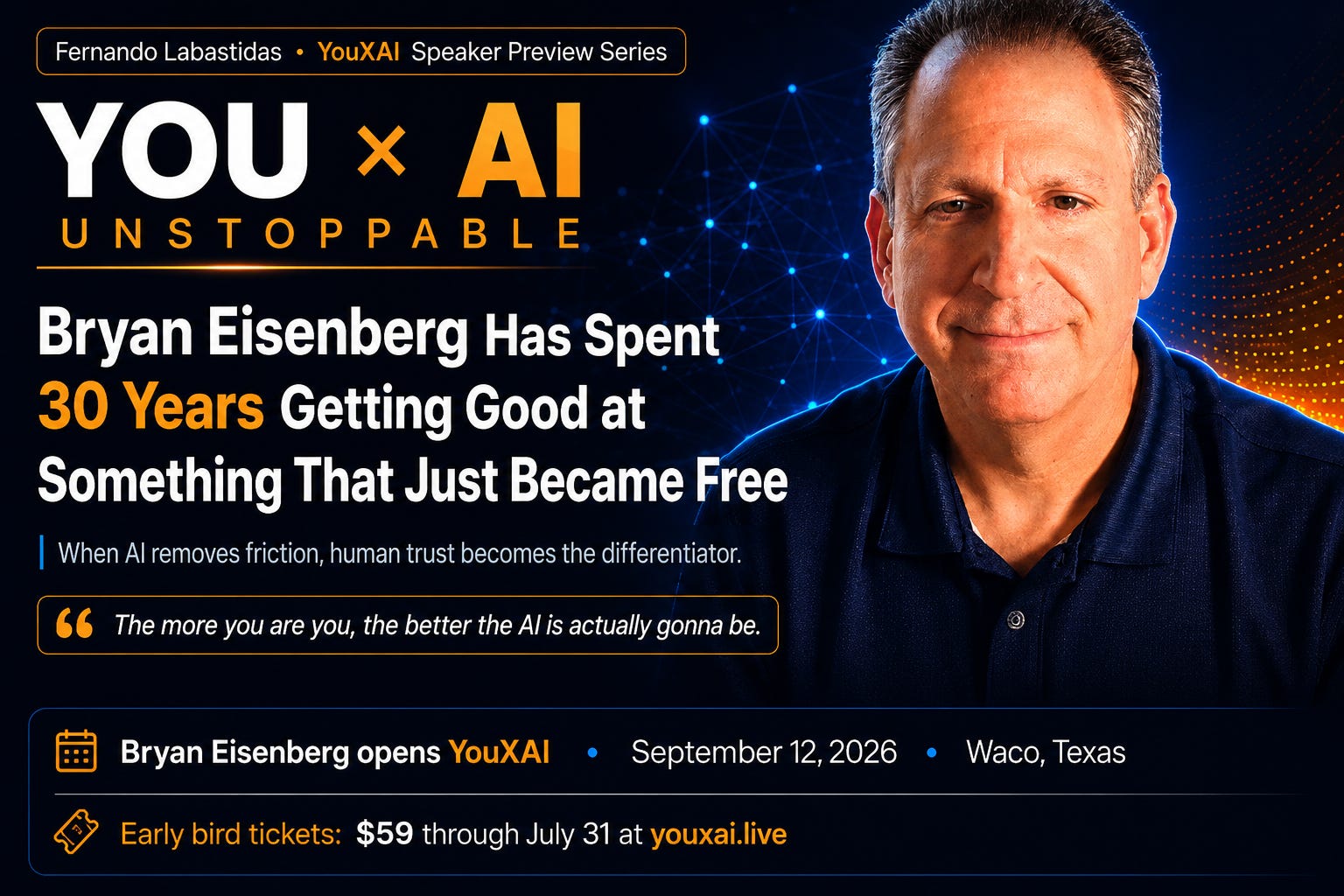
Bryan Eisenberg is opening YouXAI.
If you’ve been in marketing long enough, that name needs no introduction: Bryan and his brother Jeffrey coined the term “conversion rate optimization” back when most companies didn’t have a website worth optimizing.
Eleven books. Two million published words. Columns in The New York Times and The Wall Street Journal. Thirty years spent understanding why people say yes online.
That’s the man who walks onto our stage first on September 12 in Waco.
And it’s more than a big name on a poster. When I interviewed Bryan for the speaker preview series, he told me something disarming: everything he spent 30 years mastering can now be generated for free by AI.
Instead of flinching, he rebuilt his whole operation around the one thing that survived. That conversation is below - and don’t skip the part about the job listings that beat an industry with 80% turnover.
The summit is in Waco, Saturday, Sept. 12th, 8am to 5 PM. Early-bird tickets only $59 until July 31. Register below:
Bryan Eisenberg has spent 30 years getting good at something that just became free.
He and his brother Jeffrey coined the term “conversion rate optimization” before most marketers knew there was a science to it.
They published two million words across eleven books, wrote columns for The New York Times and The Wall Street Journal, and built an entire professional identity around understanding how to persuade people online.
It is, by any measure, hard-won expertise.
And in a preview conversation ahead of his opening keynote at YouXAI, September 12, in Waco, Bryan said the quiet part out loud: none of that scarcity protects him anymore. Anyone can generate the content he spent decades learning to write.
Every technology that ever mattered did the same thing
Bryan’s framing for this moment isn’t really about AI. It’s about friction, and the long history of technology removing it.
“What happens in each step of those, there’s friction that got removed that makes it easier for people to publish,” he said, walking through the sequence: hand-scribed books, then the printing press, then radio licenses, then a handful of TV channels, then a million streaming services, then the democratized internet.
Every step, the barrier to putting out content dropped.
“And so when you kind of inverse that, there’s no friction. In all persuasive momentum, there’s two things that you gotta work on.”
Today, he said, that friction has hit zero. “You can generate print, you can generate pictures artificially, you can generate videos now, automatically. Zero friction.”
Which leaves exactly one variable that still separates one piece of content from a million identical ones: motivation.
And the only motivation that survives zero friction, Bryan argued, is human connection. “That trust factor only happens between real humans.”
This is the exact inversion the YouXAI thesis is built on. When the technical barrier disappears, the differentiator stops being technical and becomes personal — the specific, unautomatable fact of who you are and who trusts you.
The system: one recording, five outputs, zero manual labor
Bryan didn’t leave this as theory. He built the actual production line.
Every Friday, he records one or two guests for his podcast — a show with a 12-to-15-week publishing lag long enough that, by his own admission, “I barely remember what we discussed during the podcast.”
When an episode nears publication, the old process meant manually finding the YouTube video, copying the transcript, pulling clips through a separate tool, and then writing a blog post for his podcast’s home, a separate post for his personal site, a LinkedIn post, and posts for Instagram and Facebook. Each one, by hand, one platform at a time.
“I have now automated every single one of those steps,” Bryan said, “including the initial draft of both our blog posts. But it’s doing that in a very humanized voice.”
That last clause is the whole point. He didn’t build a system that produces generic AI content across five channels. He built a system that produces his voice across five channels, faster than he could type it himself.
The job posting that beat an 80% turnover industry standard
The clearest proof of what “humanized voice, automated at scale” actually buys you didn’t come from his marketing business. It came from his home care agency.
Bryan recently interviewed Kelly Moreno, chief solution officer at Workforce Solutions Rural Capital of Texas, about aligning job requirements with real skills.
He took her advice and applied it to something that matters directly to his bottom line: how his home care agency writes job listings for caregivers.
“Telling the right story in our job listings has made our recruiting for our caregivers so much easier,” he said, “because they’re coming in with the mission. Our retention far outweighs the industry standard of 80% turnover.”
The mechanism is exactly the same one from his content system: he wrote the story once, in his own voice, and used AI to generate consistent variations in that same brand voice going forward, “because sometimes you get busy, you forget, and you don’t want to retract your own.”
The story has to start human. The scale comes from AI. In an industry defined by churn, that combination is the difference between constantly re-hiring and actually retaining people.
The Chamber calendar, or: buying back the thing AI can’t replace
Bryan is, by his own description, “almost a fixture” at the Round Rock Chamber of Commerce - at nearly every one of the more than 100 events it runs each year. That presence isn’t decorative. It’s the actual mechanism behind everything else he does.
But a weekly podcast recording collides with a Chamber event every other month, and he kept missing them.
So he built an AI agent to scrape the Chamber’s calendar month to month, cross-check it against his own schedule, and flag conflicts before they happen. As simple and unglamorous a use of AI as exists, and one of the most valuable things he’s automated.
“I want to be present in person,” he said. The AI’s entire job is protecting the thing AI can’t do for him.
Bryan traces the whole philosophy back to a line from his first mentor, long before the internet existed: “I’m temporarily motivated to be permanently lazy.”
That is, he said, “the blessing of AI.” Not removing effort from your life, but removing the repetitive effort so what’s left is the relationship-building no system can fake. “The reason I can get to do so many things is because I keep buying back my time.”
What this means for you
Bryan’s one-line summary of all of it: “The more you are you, the better the AI is actually gonna be.”
That’s not a slogan. It’s an operating instruction.
Before you automate anything, write the thing in your own voice first: the job listing, the blog post, the brand story.
Then use AI to scale that voice across every channel and every repetitive task standing between you and the next in-person conversation.
The automation isn’t the differentiator. It’s the delivery mechanism for the differentiator, which was you the whole time.
Bryan Eisenberg opens YouXAI on September 12 in Waco, and he’ll go deeper on the exact systems behind all of this.
Early bird tickets are $59 through July 31 at youxai.live.
— Fernando Labastida YouXAI Speaker Preview Series